How to chase an unpaid invoice: payment reminder templates and the UK late-payment rules
Send a payment reminder before the due date, on it, a week late and as a final notice. Three templates, plus the UK late-payment interest and fixed sums.
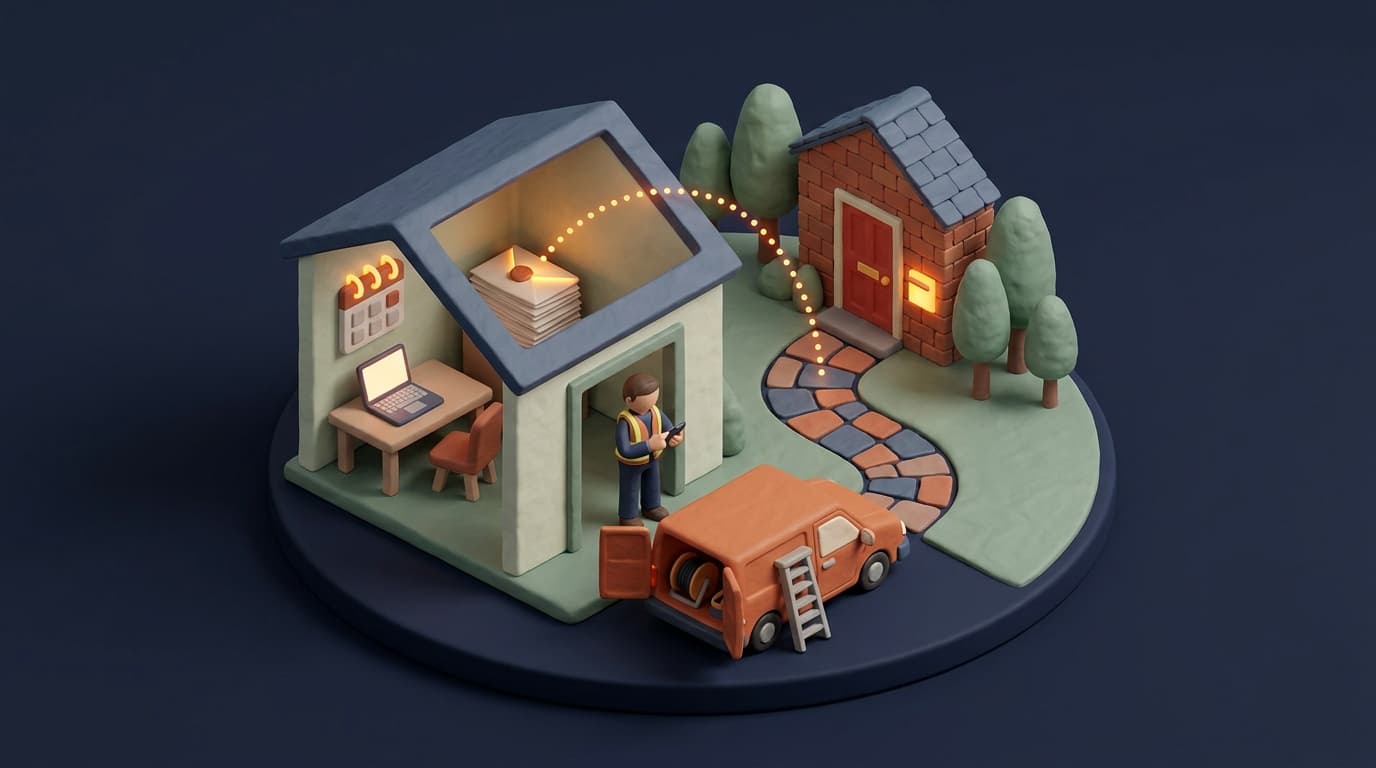
Put a due date on the invoice, send a short heads-up a few days before it, a polite reminder on the day, a firmer one with a phone call a week later and a final notice a week after that. Each message names the invoice, the amount and the date, and asks for one thing. If the customer is a business, UK law lets you add statutory interest of 8% above the Bank of England base rate and a fixed sum of £40, £70 or £100. Below are the timing, three reminder templates to copy and the rules as GOV.UK sets them out today.
Here is a made-up case. An electrician rewires a two-bedroom flat for a small letting agency. The job goes well, the tenant moves in on time, and he emails a £2,400 invoice with "payment within 30 days" at the bottom. Day 30 passes. On day 38 he realises nobody has paid, and he has no idea whether the invoice reached the right person. He writes an annoyed email at 10 pm and doesn't send it. Then a busy fortnight starts, and by the time he chases, the money is seven weeks late.
A late invoice is often not a refusal. It sits in the wrong inbox, waits for someone to approve it, or waits until the customer gets round to it. A reminder that arrives on time, with everything the customer needs to pay, fixes most of that.
What to put on the invoice so chasing is easier
The easiest invoice to chase is the one that leaves the customer nothing to ask. GOV.UK lists what every invoice must include on its page on invoices and what they must include: a unique invoice number, your business name, address and contact details, the customer's name and address, a clear description of the work, the date you supplied it, the invoice date, the amounts, VAT if it applies and the total owed. Sole traders add their own name next to any business name. Limited companies use the full registered name.
On top of that, a few things make the reminders shorter:
- A due date written as a date. "Due 14 November" leaves less room for argument than "30 days", which the customer may count from a different day.
- How to pay. Bank details with the invoice number as the payment reference, or a card payment link if you offer one.
- The customer's own reference. Business customers often need a purchase order number or the name of the person who ordered the work before accounts will pay. Ask for it when you take the job.
- Who it went to. For a business, send the invoice to the accounts address and copy the person who booked you. Ask on the first job which address they use.
- Your late-payment terms, for business customers. One line such as "Late payments may incur interest and recovery costs under the Late Payment of Commercial Debts (Interest) Act 1998" tells them you know the rules. Leave it off invoices to homeowners, because the Act doesn't cover them.
- A link to the quote. If the price changed during the job, say why on the invoice. A surprise on the bill gives a homeowner a reason to hold back payment.
Send the invoice the day the work is finished, while the customer is still pleased with it.
The payment reminder sequence, with timing
Three days before the due date, a heads-up. Short and friendly, and optional for customers who always pay on time. It catches the invoice that never arrived while there is still time to resend it. A text works: "Hi [name], just a note that invoice [number] for [job] is due on Friday. Shout if you haven't got it. [Your name]"
On the due date, the polite reminder. Assume it slipped through. Attach the invoice again, give the amount and the payment details, and ask them to let you know if anything is holding it up. This is Template 1.
A week late, the firm reminder and a phone call. Ring first. A two-minute call tells you more than any email: whether there is a problem with the work, whether it is waiting for someone's sign-off, or whether the customer is short of money this month. Then send Template 2, which confirms what was said and asks for a payment date.
Two weeks late, the final notice. Give a date seven days ahead and say exactly what you will do if payment hasn't arrived by then. For a business customer, that can include adding interest and the fixed sum. Only name a step you are prepared to take. This is Template 3.
After the final notice. Stop sending reminders and decide. Offer a payment plan in writing first, with dates and amounts. If that fails, GOV.UK says a mediation service could be quicker and cheaper than going to court. The same guide explains how to make a claim in the county court in England and Wales, online or by post. Scotland and Northern Ireland have their own process.
If the customer replies at any point with a question or a complaint about the work, the sequence pauses until you have answered it. Chasing an invoice the customer is disputing makes the dispute worse.
Payment reminder templates
These are templates. Replace everything in square brackets and write them in your own voice. Keep them short, and send each one as a reply to the email that carried the invoice, so the customer has the invoice and the history in one thread.
Template 1. The polite reminder, on the due date
Subject: Invoice [number] for [job], due today
Hello [Customer name],
A quick reminder that invoice [number] for [job] at [address], £[amount], is due today. I've attached it again in case the first one went astray. You can pay by bank transfer to [account name, sort code, account number] using [invoice number] as the reference.
If anything on the invoice needs explaining, ring me on [phone number] and I'll go through it.
Best wishes, [Your name], [Business name]
Template 2. The firm reminder, a week late
Subject: Invoice [number], now 7 days overdue
Hello [Customer name],
Thanks for talking to me today. As we discussed, invoice [number] for [job], £[amount], was due on [due date] and is now seven days overdue. [One sentence on what was agreed. Example: You said accounts will pay it in Thursday's run.]
Please confirm the date you will pay it. I've attached the invoice again with the payment details.
Regards, [Your name], [Business name], [phone number]
If nobody answers the phone, drop the first sentence and ask them to reply with a payment date.
Template 3. The final notice, two weeks late
Subject: Final notice, invoice [number], £[amount]
Dear [Customer name],
Invoice [number] for [job] at [address], £[amount], was due on [due date]. I have sent reminders on [date] and [date] and have not received payment or a reason for the delay.
Please pay the full amount by [date seven days from today]. If payment has not arrived by then, [the step you will take. For a business customer: I will add statutory interest and a fixed debt recovery charge under the Late Payment of Commercial Debts (Interest) Act 1998 and consider a court claim. For a homeowner: I will consider a court claim.]
If there is a problem with the work or the invoice, tell me before that date and I will look at it.
Yours sincerely, [Your name], [Business name], [phone number]
The final notice is the only one that sounds formal, and that is deliberate. By this point the customer should be able to tell from the first line that this one is different.
The UK late-payment rules for business customers
The rules on interest and fixed sums come from the Late Payment of Commercial Debts (Interest) Act 1998. GOV.UK sets them out in its guide to late commercial payments. They apply when another business pays you late for goods or a service. A letting agency, a builder you subcontract for or a shop that hired you to rewire it are business customers. A homeowner is not.
When a payment is late. If you agreed a payment date, it is late the day after. GOV.UK says an agreed date must usually be within 60 days for business transactions and 30 days for public authorities, and a longer period between businesses must be fair to both. If you agreed no date, the payment is late 30 days after the customer gets the invoice or after you do the work, whichever is later.
Statutory interest. According to GOV.UK's page on interest on late commercial payments, you can charge 8% plus the Bank of England base rate on business-to-business debts. You can't claim statutory interest if your contract sets a different interest rate. Check the current base rate on the Bank of England website before you work it out. GOV.UK also says to send a new invoice if you decide to add interest.
To work out the daily figure, multiply the debt by the rate and divide by 365. As an illustration only, if the base rate were 4%, the rate would be 12%. On the £2,400 invoice from the example that is £288 a year, about 79p a day, or about £23.70 after 30 days.
Fixed debt recovery costs. GOV.UK's page on claiming debt recovery costs gives the fixed sums set by the legislation:
| Size of the debt | Fixed sum you can charge |
|---|---|
| Up to £999.99 | £40 |
| £1,000 to £9,999.99 | £70 |
| £10,000 or more | £100 |
You can charge the fixed sum once for each payment, and GOV.UK says you can also claim reasonable costs each time you try to recover the debt.
Being entitled to interest doesn't mean you have to charge it. With a builder who gives you work every month and paid ten days late once, a phone call keeps the relationship and the interest comes to a few pounds. With a customer who pays late every time, mentioning the Act in the final notice tells them your invoice costs more the longer it waits. I'm not a lawyer, so for a large debt or a disputed one, ask a solicitor or your trade association before you add charges.
Homeowners and other consumers
The Act covers business-to-business debts only, so the statutory interest and the fixed sums above don't apply when a homeowner pays late. Anything you want to charge a homeowner for late payment has to be in the terms they agreed before the work started, and consumer law requires those terms to be fair. Ask your trade association or a solicitor before you rely on a late-payment clause with homeowners.
With homeowners, the phone call does most of the work. A late payment from a household often means a question about the bill, a problem with the job or a cash-flow gap. Offer a payment plan in writing before you send anything stern.
A note for US contractors
The timing and the templates work the same in the US. The rules on late fees, interest and lien rights vary from state to state, and so do the deadlines that go with them. Before you add a late fee or mention one in a reminder, check what your contract says and what your state's law allows, or ask your state contractors' association or a local attorney.
Where an AI assistant helps
Writing the second and third reminder is the part most owners put off, and a general chat assistant drafts them in a minute. Give it the invoice number, the amount, the due date and what the customer said on the phone, and ask for a reminder in the style of the templates above. Read it before it goes, and check the figures against the invoice yourself, because an assistant can get a sum or a date wrong and sound sure about it.
The schedule itself usually belongs in your accounting software. Many packages can send reminders automatically before and after the due date, so check yours before you set up anything new. We build the Aristotle System, seven AI employees for trade businesses, and none of them chases invoices. Our examples of AI for tradespeople cover the office jobs where AI does help and what stays with you in each.
The tone rules from how to follow up on a quote carry over. Name the job, ask one question the customer can answer quickly, and keep pressure out of the first two messages. If a lot of your invoices go to homeowners who message you, WhatsApp Business for tradespeople shows how to keep job messages in one place.
The electrician from the example now writes the due date on the invoice and puts two reminders in his calendar the day he sends it. The letting agency's accounts team has his invoices on file under the right address.
Frequently asked questions
How do you politely chase an unpaid invoice?
Send a short reminder on the due date that names the invoice number, the job, the amount and the date, attaches the invoice again and gives the payment details. Assume it was missed rather than ignored, and offer to explain anything on it. If it is still unpaid a week later, ring the customer before you send a firmer email.
When is an invoice overdue in the UK?
When the agreed payment date has passed. If no date was agreed, GOV.UK says a payment between businesses is late 30 days after the customer gets the invoice or after you do the work, whichever is later. Write the due date on the invoice as a date so nobody has to work it out.
Can I charge interest on a late payment in the UK?
From a business customer, yes. Under the Late Payment of Commercial Debts (Interest) Act 1998 you can charge statutory interest of 8% plus the Bank of England base rate, unless your contract sets a different rate. The Act doesn't cover homeowners and other consumers, so for them you can only charge what fair terms agreed before the job allow.
How much is the late payment fee for an unpaid invoice in the UK?
For business-to-business debts, GOV.UK lists fixed debt recovery sums of £40 for debts up to £999.99, £70 for £1,000 to £9,999.99 and £100 for £10,000 or more. You can charge the fixed sum once for each payment, on top of statutory interest, and you can claim reasonable further costs of recovering the debt.
What should a final payment reminder say?
The invoice number, the job, the amount, the original due date and the dates of your earlier reminders. Then one deadline, usually seven days ahead, and the step you will take if payment hasn't arrived by then. Name only steps you will actually take, and invite the customer to raise any problem with the work before the deadline.